
Define what the receiving team needs to identify
Begin the packaging brief with the people who will open the shipment. Will they receive one style and color at a time, allocate complete assortments or send cartons onward to different locations? Ask them which identifiers must be visible before a carton is opened. A packing method can protect the hats and still create unnecessary sorting work if it combines products that the receiving team expects to handle separately.
Give the supplier the same style, colorway and size codes used in the purchase order. Add the quantity for every combination and any destination split. State whether mixed cartons are permitted, which combinations may share a carton and how a mixed carton should be identified. If a receiving team has its own packing or label specification, supply the current version before the packaging proposal is prepared.
Keep the receiving requirement separate from the packaging method. A request for one color per carton tells the factory how to group the goods; it does not determine the number of hats that can be packed safely. Ask for a proposal that connects both decisions. Record unresolved questions, including individual wrapping, hangtag handling and any packing materials you want the supplier to quote separately.
Review the packing method against the hat shape
Use the approved hat construction when discussing protection. A supported cap crown, a curved brim and a soft bucket hat do not present the same packing problem. Ask how the proposed arrangement supports the actual product and which surfaces will touch during transport. Do not approve a method from a photograph of a different hat merely because the outside carton appears suitable or holds the quantity you hoped to ship.
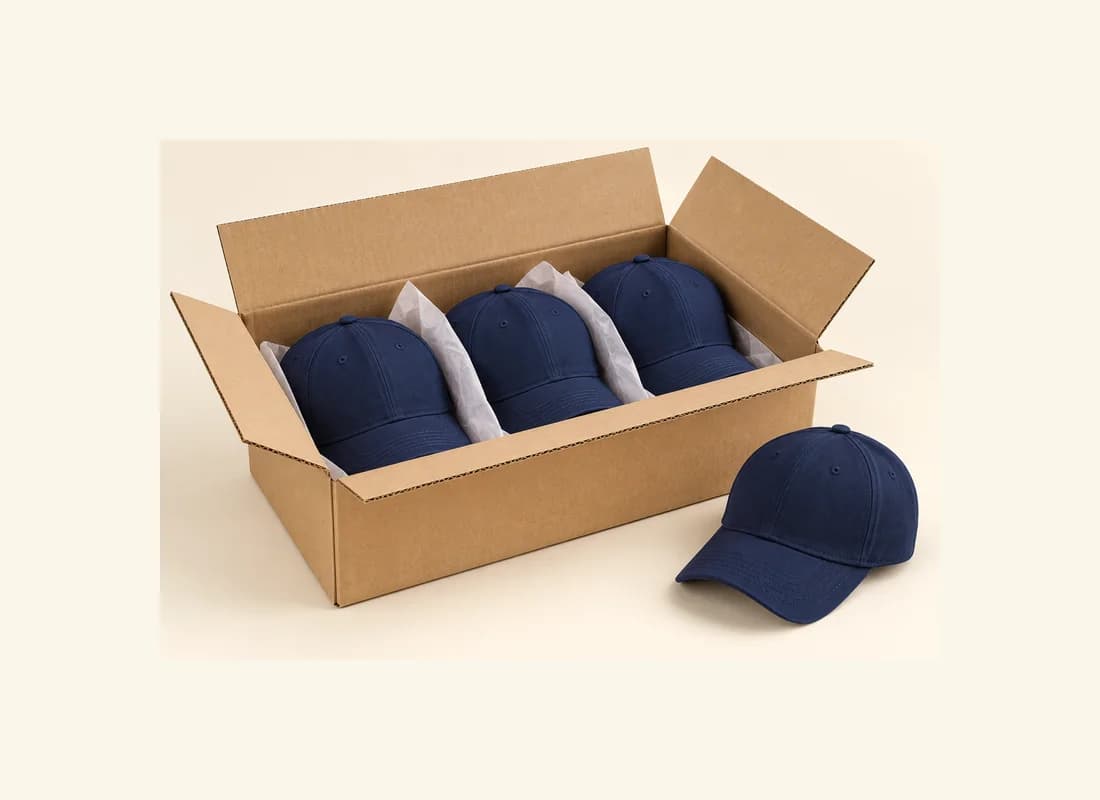
Where the supplier proposes nesting caps, inspect how the crowns and brims sit together and whether labels, closures or decoration press against another hat. Ask which separators, supports or individual coverings are included. Check the packed arrangement and then inspect the hats after unpacking for visible changes to the crown, brim or surface. The illustration below highlights shape pressure; it is not a prescribed packing method for every construction.
FedEx's packing guidance starts with choosing suitable packaging and cushioning, then sealing and labeling the package. Those are useful general checks, but they do not establish a universal cap count or carton dimension. Agree a packaging sample for your hat and intended transport method. If additional transit testing is needed, define its scope and acceptance criteria with the relevant supplier or carrier before treating a tidy packing photograph as evidence of protection.

- Use the approved hat construction
- Review contact and pressure points
- Check the hat after unpacking
Calculate full cartons and partial cartons separately
Once the proposed packing arrangement is acceptable, ask the supplier to confirm the planned quantity per carton. Calculate the full cartons and the remaining quantity for each permitted grouping. Keep those calculations attached to the style, color and size breakdown. A shipment total alone cannot show whether one carton mixes two colorways or whether a small remainder has been left out of the packing plan.
Record the partial carton as an explicit line. Identify its contents, quantity and proposed packaging rather than assuming it will use the full-carton arrangement with empty space left over. Ask how the remaining products will be held in position. If the supplier proposes combining remainders, check that mixed cartons are allowed and that the receiving team can identify every item without reconstructing the order from loose hats.
Request the final external carton dimensions and gross weight after the proposed method has been checked. Keep estimates labeled as estimates until that confirmation. If the carton size or packing count changes, recalculate the carton total and review the transport quotation with the responsible party. The packing count is an order-specific result of the approved arrangement, not a fixed manufacturing promise or an assumed standard for all baseball caps.
Make carton marks match the packing list
Agree the carton identification before printing it. A practical draft names the order reference, style, color, size where applicable, contents quantity and carton number. The receiver may require additional fields or a different arrangement, so request their actual instructions. Keep internal carton marks distinct from the carrier's shipping label. One identifies the contents for receiving; the other supports the transport process and may be supplied separately.
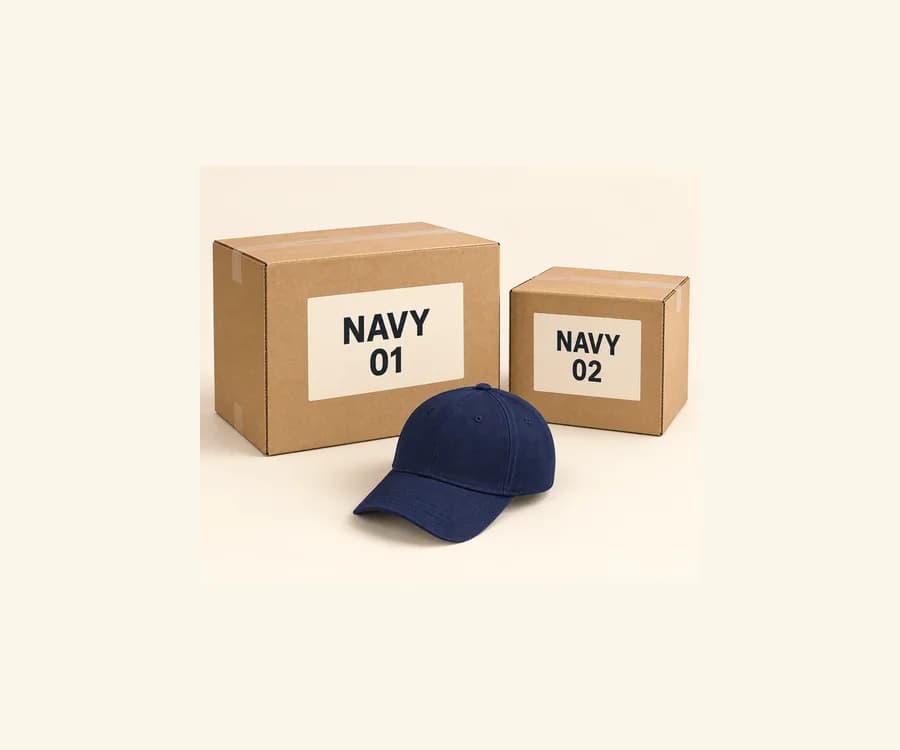
Use one agreed numbering system and repeat those numbers on the packing list. For mixed cartons, list the quantities of each combination against the relevant carton rather than using a single ambiguous total. Identify a partial carton clearly in the record. The two-carton illustration below shows distinct identifiers for a matching colorway; your final mark should contain the full set of fields agreed for your order.
Review a draft label and a draft packing-list row together. Check that the product names, codes and quantities agree with the purchase order. If the receiver supplies barcode artwork or an electronic label file, have them confirm the required file and check a printed sample using their receiving process. Do not create an arbitrary code or assume that a visible barcode alone proves the shipment can be received correctly.
- Use agreed style and color codes
- List the contents by carton number
- Identify partial cartons in the record
Approve one complete packing reference
Ask for a review that shows the product arrangement before closing the carton, the protective materials, the closed carton and the identification mark. Tie those views to a named packing revision and the actual hat sample. If the method includes inner groups, show how they are formed and identified. State what the photographs demonstrate and what still needs physical review, especially when crown shape or surface contact is uncertain.
Check that the approved proposal agrees with the commercial scope. Confirm which materials, labels and packing operations are included, and identify any unresolved changes before the production handoff. Keep packing approval separate from the final receiving address and transport booking, while making sure the people arranging those steps have the latest carton information. A change in grouping can affect more than the person placing hats in a box.
If the supplier changes the count, carton, support or wrapping after approval, ask for the affected details to be reviewed again. Preserve the earlier revision in the history but mark the current instruction clearly. The final record should let another team member reproduce the agreed arrangement and reconcile the shipment quantities without relying on a series of informal messages sent at different stages of the order.
- Product: approved construction, style, color and size codes.
- Method: arrangement, supports, coverings and inner groups.
- Count: full cartons, partial cartons and reconciled totals.
- Identification: carton marks, packing-list rows and revision.
Example: keep a small remainder visible in the plan
Consider an illustrative order with 120 navy caps and 100 cream caps of one style. Suppose the proposed, reviewed packing count is 40 pieces per full carton and the buyer requires separate colorways. Navy needs three full cartons. Cream needs two full cartons and one partial carton of 20. The plan therefore contains six cartons and 220 hats. Forty pieces is an example assumption, not FORMBRIM's standard carton capacity.
A useful instruction reads: “Keep navy and cream separate. Record the three navy cartons as 40 pieces each, the two full cream cartons as 40 each and the remaining cream carton as 20. Propose protection for the partial carton and confirm its final dimensions and gross weight. Use the agreed carton numbering on both the carton marks and packing list. Packaging approval is pending the partial-carton review.”
Reconcile the resulting list back to the order before releasing it: navy 120, cream 100, total 220. If the packing trial changes the capacity, update every affected carton row rather than editing only the shipment total. Send the confirmed arrangement, identification artwork and receiving requirements together. The goal is a bulk hat packaging specification that protects the approved product and makes its contents straightforward to verify at the destination.