
Start with one cut-and-sewn crown proposal
A seam strength test request needs an identified connection and a question it can answer. For a curved knitted crown, a force figure from an unspecified specimen cannot decide which sewing proposal should move forward. The immediate buying decision may be a narrower one: clarify the construction, request a local revision, or leave performance approval pending until a suitable assessment is established.
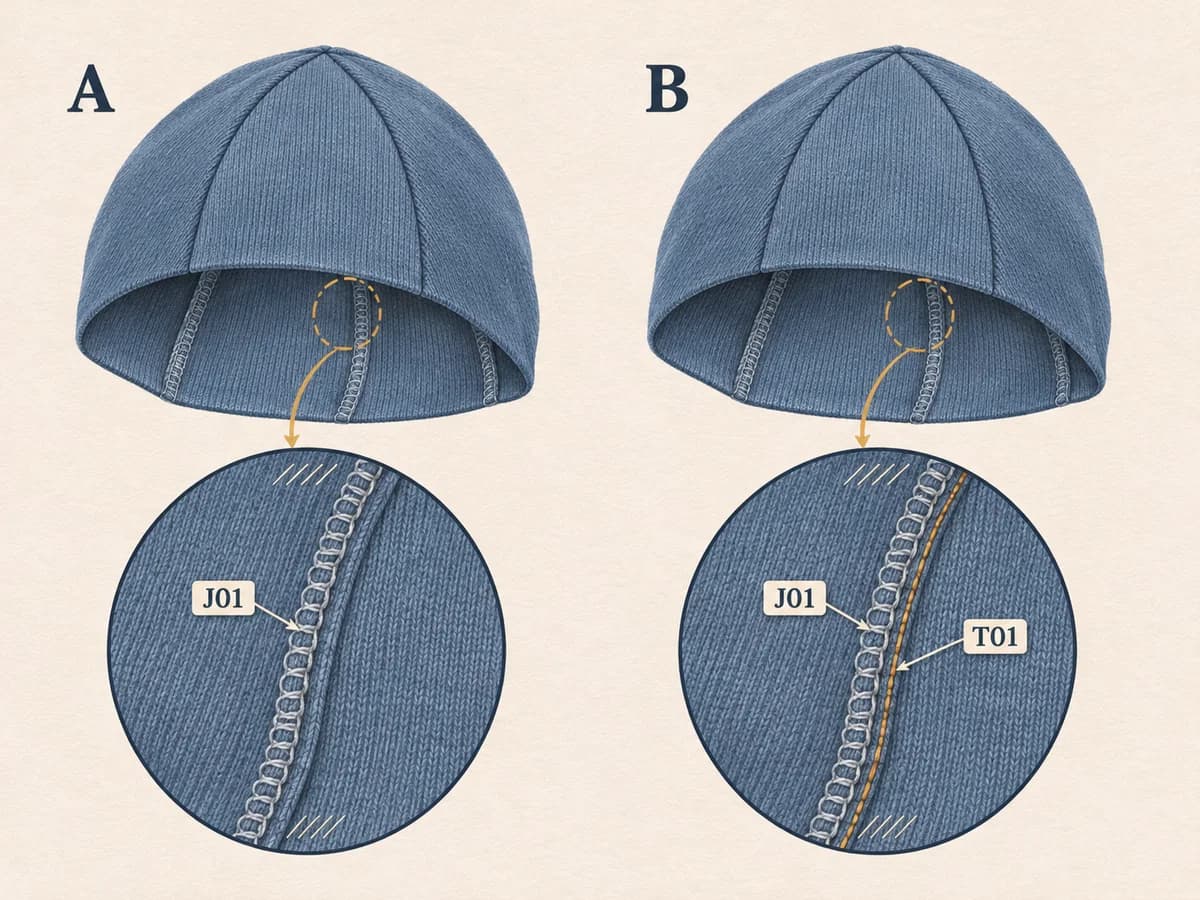
Consider a hypothetical crown made from four shaped cut-knit gores, C1–C4. They are cut from one identified cloth reference, F-HYP-01, and sewn together; this is not a linked, fully fashioned knit construction. J01 joins adjacent panels C1 and C2 along their curved edges. Only its middle segment, M01, is under review. The apex intersection and the lower opening or cuff junction are excluded.
Proposal A has a four-thread overedge joining seam. Proposal B retains that base join and adds one retaining row, T01. Cloth, pattern revision, orientation and lower opening stay the same in the proposed comparison. These drawings describe an illustrative buyer request, not a FORMBRIM order, tested sample or confirmed specification. No strength result or construction winner is supplied.
Draw the layers that the added row must catch
In both proposals, the two seam allowances lie together toward C2. In B, T01 is one single-needle, two-thread lockstitch retaining row following the curved middle segment beside J01. It passes through both allowances and C2 only. It does not catch the main body of C1. Mark the same inside and outside views, cloth wale/course references and M01 limits so that an apparently similar line cannot stand in for a different connection.
The layer inset explains that proposed path; it does not specify allowance width, row clearance, stitch density or endpoint treatment. Those details require the responsible sewing team. Nothing is prescribed for the excluded apex or lower junction, and a decision about M01 cannot approve them. The extra row is an option to assess, rather than a recommendation for knitted headwear.
Presence or absence of T01 is the intended design difference, but making it can introduce coupled changes in needle operation, thread, stitch formation, tension or feed. Record those changes instead of calling the comparison a single-cause experiment. Feasibility, extension, inside contact, puckering and crown shape remain questions for an actual proposal and sample.
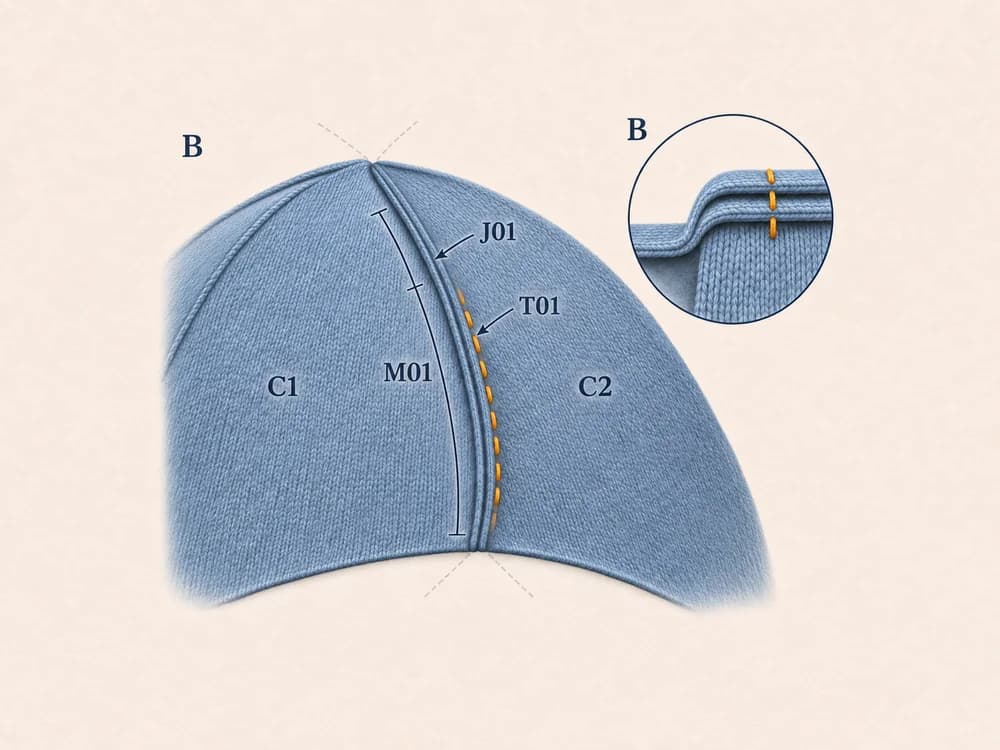
- Keep both allowances laid toward C2 in A and B.
- T01 catches both allowances and C2 only.
- Exclude the apex and lower-opening junctions.
Keep method selection on HOLD for the curved join
METHOD HOLD means that no applicable specimen or assembled-crown assessment route has been established for this example. The public scopes of ISO 13935-1:2014 and ISO 13935-2:2026 concern straight sewn seams; they do not validate curved J01. Possible applicability beyond woven fabrics is conditional, not blanket approval of this knit. ASTM D1683/D1683M addresses sewn woven fabrics and is not adopted for this crown.
Cutting out the curve and flattening it on a bench does not establish a straight seam or representative specimen. A future straight sewn-knit control would be a separate question for a qualified provider. Even if that route were justified, its result would belong to that specimen and stated scope, not automatically to M01, the apex, lower junction, finished fit or wear.
Send the actual cloth, proposed connection, geometry and assessment question to a technically competent provider. Ask what can be represented and what must remain excluded. Until that is resolved, do not choose specimen dimensions, loading arrangements, speed, force or an acceptance threshold from an unrelated method. Hand stretching, photographs and an unexplained maximum-force figure do not close this hold.
Let the observation determine the next question
The three illustrated conditions are possible observations, not outcomes for A or B. Groz-Beckert treats material damage, thread breakage and stitch-formation problems as distinct concerns involving several interacting variables. A photograph can locate a question; it cannot establish its cause. Ask the technical owner to confirm ambiguous thread and layer identities before choosing a revision.
- Damaged knit loops near J01 or T01: mark their position relative to needle penetrations. Request material-sewability and needle/formation review before naming one proposed material or formation change. Do not diagnose sewing damage or weak cloth from appearance alone.
- Broken sewing thread or an incomplete stitch path: identify which path and layer are involved. Ask whether J01 and T01 were formed as specified, then request a named local sewing revision. A stronger thread is not an automatic remedy.
- An opening with identified sewing threads still continuous: establish which layers separate and which edges and allowances T01 catches. Request connection-path and edge-capture review. Do not rename this observation woven yarn slippage or assume that an additional row fixes it.
- Mixed or uncertain observations: leave the A/B performance decision and method selection on HOLD. Request the missing identity or applicability evidence instead of filling an empty comparison with an assumed result.
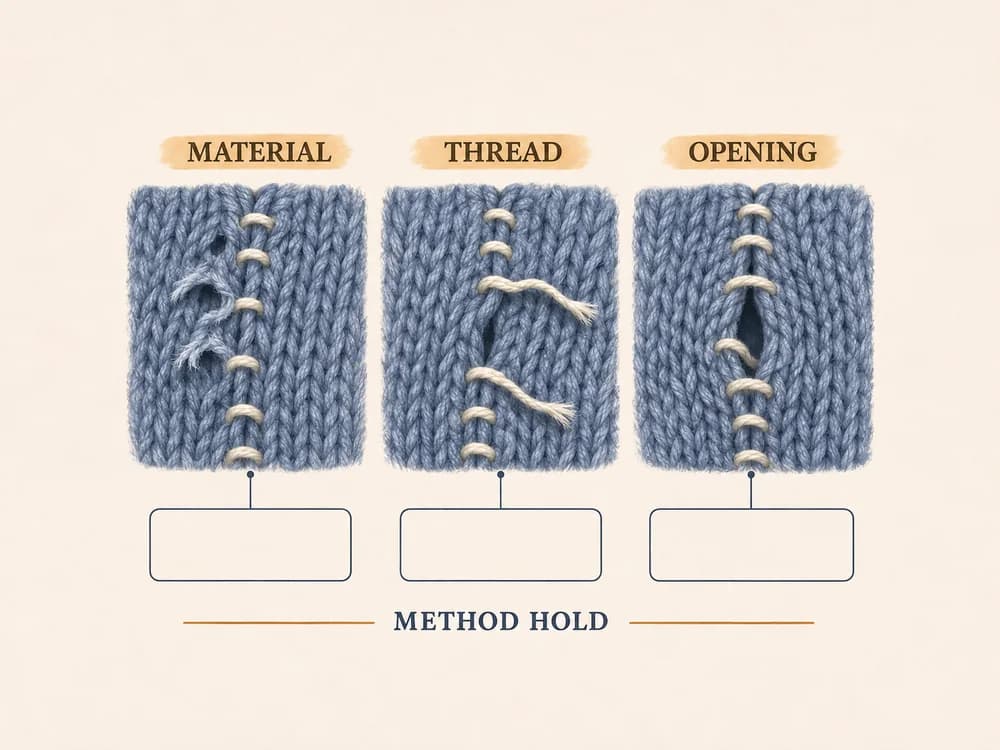
- Locate damage and identify the thread or layer involved.
- Request qualified review before naming a revision.
- Keep method and strength approval on hold.
Request a local revision without releasing performance
An actionable response might read: “At M01, please clarify whether the visible discontinuity belongs to the knit or the sewing thread. Retain the agreed crown pattern and allowance direction. Identify one proposed change and the evidence needed to assess it.” If the layer path is unclear, ask for that clarification before asking for a modified sample.
Keeping B as a development option does not mean accepting B as stronger, safer or suitable for bulk. Review any proposed change with the sewing team, then check the next identified sample for the intended layer path, crown geometry and inside contact. These observations remain separate from a strength conclusion. Where no representative route is available, the useful output is still a precise next request with performance approval pending.
Send the join drawing and the unresolved decision together
Send the cloth identity, C1–C4 pattern revision, J01/M01 views, A/B layer paths and current observations together. State whether the request concerns construction clarification, one next-sample revision or an unresolved assessment. Keep the excluded junctions visible and name who must answer the technical question. This article supplies no test procedure, measured result or approved knit-seam recipe.
FORMBRIM provides OEM/ODM headwear development with a published minimum of 300 pieces per style, per color. Discuss the proposed construction and sampling scope for your order; this illustrative case establishes neither the exact assembly capability nor an in-house laboratory or confirmed test service.